Isaac Asimov e l’inganno dell’ignoranza
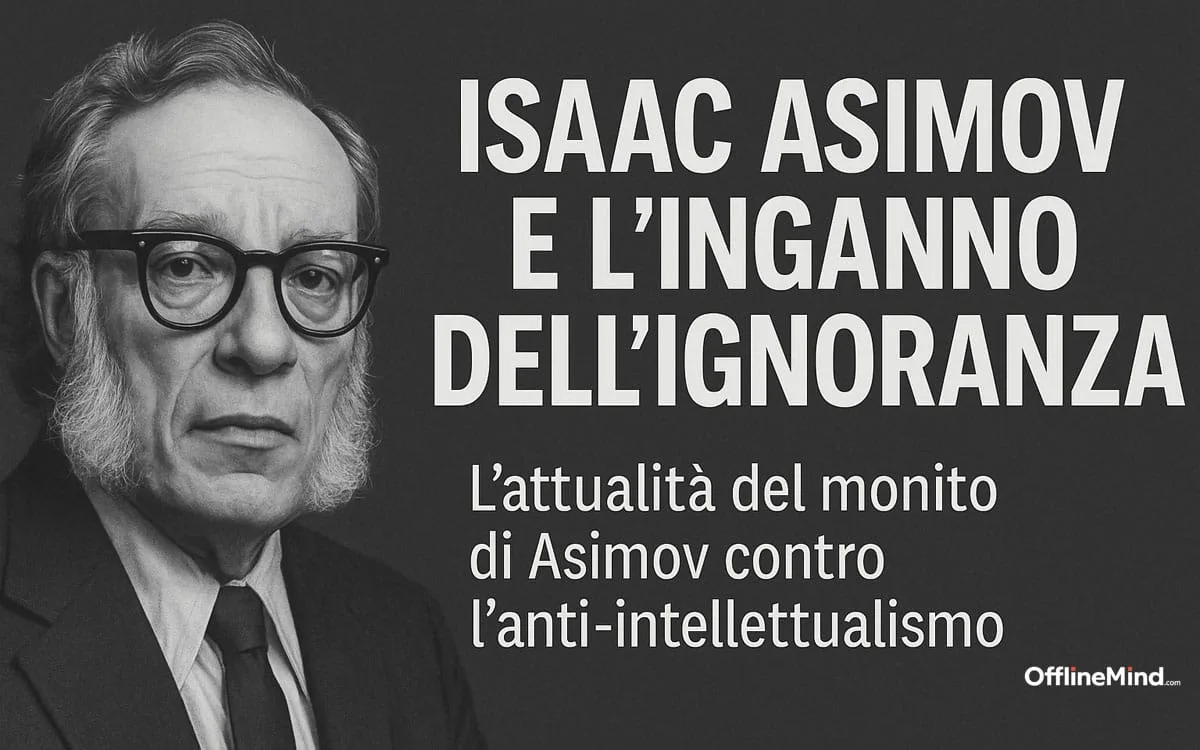
L’attualità del monito di Asimov contro l’anti-intellettualismo
Ci sono frasi che fanno il giro dei social e diventano slogan. Una di queste, attribuita a Isaac Asimov, dice: “La mia ignoranza vale quanto la tua cultura”.
Suona bene, ma non è proprio quello che disse.
Nel 1980 Asimov scrisse su Newsweek un pezzo intitolato “A Cult of Ignorance”. Non parlava per metafore: denunciava un Paese dove si stava diffondendo un culto pericoloso, quello dell’anti-intellettualismo.
La gente, diceva, cominciava a credere che democrazia volesse dire: “la mia ignoranza è valida quanto la tua conoscenza”.
Non usava la parola “cultura”: parlava di conoscenza vera. Studi, fatti, esperienza. Tutto ciò che distingue chi cerca di capire da chi preferisce restare al buio.
Oggi questo inganno è ancora più forte. Lo vediamo quando qualcuno dice che i vaccini sono un complotto, che il cambiamento climatico è un’invenzione, che un influencer sa più di un medico. Lo vediamo ogni volta che un “mi sembra” o un “secondo me” pretende di valere quanto anni di studio.
Democrazia non vuol dire questo.
Vuol dire che tutti possono parlare, ma non che ogni parola pesa allo stesso modo.
Vuol dire che puoi dire la tua, ma non che la tua ignoranza diventa verità solo perché la gridi più forte.
Asimov ci avvertiva: se smettiamo di distinguere tra sapere e non sapere, la democrazia diventa una farsa.
Non è un discorso teorico. È il rischio che viviamo ogni giorno, nelle urne, nei social, perfino nelle nostre conversazioni.

Un culto dell’ignoranza
(traduzione dall’inglese)
Isaac Asimov – My Turn, Newsweek, 1980
È difficile discutere con quella antica giustificazione della libertà di stampa: “Il diritto dell’America a sapere.”
Sembra quasi crudele chiedere, ingenuamente: “Il diritto dell’America a sapere cosa, esattamente? Scienza? Matematica? Economia? Lingue straniere?”
Nessuna di queste cose, naturalmente. Anzi, si potrebbe ben supporre che il sentimento comune sia che gli americani stiano molto meglio senza tutte quelle sciocchezze.
Negli Stati Uniti esiste un culto dell’ignoranza, e c’è sempre stato. Il filo dell’anti-intellettualismo ha attraversato costantemente la nostra vita politica e culturale, alimentato dalla falsa nozione che democrazia significhi che “la mia ignoranza vale quanto la tua conoscenza.”
I politici si sono sforzati regolarmente di parlare la lingua di Shakespeare e Milton nel modo più sgrammaticato possibile, per non offendere il pubblico dando l’impressione di aver studiato. Così Adlai Stevenson, che lasciava intravedere intelligenza, cultura e arguzia nei suoi discorsi, vide il popolo americano correre verso un candidato presidenziale che inventò una versione tutta sua dell’inglese, diventata la disperazione dei satirici da allora.
George Wallace, nei suoi discorsi, prendeva di mira i “professori dalla testa appuntita”, e quella frase veniva sempre accolta con un boato di approvazione dal suo pubblico “dalla testa appuntita”.
Oggi gli oscurantisti hanno trovato un nuovo slogan: “Non fidarti degli esperti!” Dieci anni fa gridavano: “Non fidarti di chi ha più di trent’anni.” Ma il calendario li ha trasformati inevitabilmente in over-30, quindi hanno cambiato bersaglio. “Non fidarti degli esperti!” è sicuro: né il tempo né l’esposizione alle informazioni li trasformeranno mai in esperti.
Abbiamo anche una nuova parola d’ordine: “elitista”. È la più comica di tutte. È stata inventata perché chi non fa parte dell’élite intellettuale non sa nemmeno cosa significhi la parola, né come pronunciarla. Ma appena qualcuno grida “elitista”, è chiaro che si sente in colpa per aver studiato.
D’accordo, lasciamo perdere la mia ingenua domanda. Il diritto dell’America a sapere non include le conoscenze “elitiste”. Si riduce piuttosto a sapere “che cosa sta succedendo”: nei tribunali, al Congresso, alla Casa Bianca, nei consigli industriali, nelle agenzie regolatrici, nei sindacati.
Molto bene, anch’io sono d’accordo. Ma come far sapere tutto ciò al popolo? Ci dicono: concedeteci una stampa libera, reporter indipendenti e coraggiosi, e allora la gente saprà.
Sì, a patto che sappia leggere!
E qui sta il punto: leggere è proprio una di quelle materie “elitiste” di cui parlavo, e il pubblico americano, nel suo disprezzo degli esperti e dei professori, non sa leggere e non legge.
Certo, l’americano medio sa firmare il proprio nome in modo più o meno leggibile e leggere i titoli sportivi, ma quanti riescono a leggere mille parole consecutive di un testo fitto e complesso? Pochissimi. E la situazione peggiora. I punteggi di lettura nelle scuole calano costantemente. Perfino i segnali stradali, che un tempo erano piccole lezioni di lettura (“Go Slow”, “X Road”), vengono ora sostituiti da figure e pittogrammi comprensibili internazionalmente, per chi non sa leggere.
Anche gli spot televisivi contengono spesso messaggi scritti. Ma guardateli bene: nessun pubblicitario crede che qualcuno li legga, a parte qualche “elitista” occasionale. Per questo ogni parola viene letta ad alta voce dall’annunciatore.
Ecco quindi la domanda: se nessuno legge, come fa l’America ad avere “il diritto di sapere”? Certo, ci sono pubblicazioni che si sforzano onestamente di informare, ma quanti le leggono davvero?
Su 200 milioni di americani che hanno passato del tempo sui banchi di scuola, la maggior parte si vergogna a leggere apertamente, e perfino le riviste più serie si considerano fortunate se raggiungono una tiratura di mezzo milione. Questo significa che, forse, appena l’1% degli americani esercita il suo “diritto di sapere”.
Io sostengo che lo slogan “Il diritto dell’America a sapere” è privo di senso se la popolazione resta ignorante, e che la funzione di una stampa libera è pressoché nulla se quasi nessuno sa leggere.
Che cosa fare, allora?
Forse dovremmo cominciare a chiederci se l’ignoranza sia davvero così meravigliosa, e se abbia senso condannare l’“elitismo.”
Io credo che ogni essere umano con un cervello normale possa imparare molto e perfino diventare sorprendentemente intellettuale. Credo che ciò di cui abbiamo più bisogno sia l’approvazione sociale dell’apprendimento e il riconoscimento del sapere.
Possiamo tutti far parte dell’élite intellettuale e solo allora, e soltanto allora, frasi come “Il diritto dell’America a sapere” – e persino l’idea stessa di democrazia – avranno davvero un significato.
A CULT OF IGNORANCE
Isaac Asimov / My Turn – Newsweek, January 21, 1980
It is hard to quarrel with that ancient justification of the free press: “America’s right to know.”
It seems almost cruel to ask, ingenuously, “America’s right to know what, please? Science? Mathematics? Economics? Foreign languages?”
None of those things, of course. In fact, one might well suppose that the popular feeling is that Americans are a lot better off without any of that tripe.
There is a cult of ignorance in the United States, and there always has been. The strain of anti-intellectualism has been a constant thread winding its way through our political and cultural life, nurtured by the false notion that democracy means that “my ignorance is just as good as your knowledge.”
Politicians have routinely striven to speak the language of Shakespeare and Milton as ungrammatically as possible, in order to avoid offending their audiences by appearing to have gone to school. Thus, Adlai Stevenson, who incautiously allowed intelligence and learning and wit to peep out of his speeches, found the American people flocking to a Presidential candidate who invented a version of the English language that was all his own and that has been the despair of satirists ever since.
George Wallace, in his speeches, had, as one of his prime targets, the “pointy-headed professor”—and with what a roar of approval that phrase was always greeted by his pointy-headed audience.
Now we have a new slogan on the part of the obscurantists: “Don’t trust the experts!” Ten years ago it was “Don’t trust anyone over 30.” But the shouters of that slogan found that the inevitable alchemy of the calendar converted them to the untrustworthiness of the over-30, and, apparently, they determined never to make that mistake again. “Don’t trust the experts!” is absolutely safe. Nothing—neither the passing of time nor exposure to information—will convert these shouters to experts in any subject that might conceivably be useful.
We have a new buzzword, too, for anyone who admires competence, knowledge, learning and skill, and who wishes to spread it around. People like that are called “elitist.” That’s the funniest buzzword ever invented, because people who are not members of the intellectual elite don’t know what an “elitist” is, or how to pronounce the word. As soon as someone shouts “elitist,” it becomes clear that he or she is a closet elitist who is feeling guilty about having gone to school.
All right, then, forget my ingenuous question. America’s right to know does not include knowledge of elitist subjects. America’s right to know involves something we might express vaguely as “what’s going on.” America has the right to know what’s going on in the courts, in Congress, in the White House, in industrial councils, in the regulatory agencies, in labor unions—in the seats of the mighty, generally.
Very good, I’m for that, too. But how are you going to let people know all that? Grant us a free press, and a corps of independent and fearless investigative reporters, comes the cry, and we can be sure that the people will know.
Yes—provided they can read!
As it happens, reading is one of those elitist subjects I have been talking about, and the American public, by and large, in their distrust of experts and in their contempt for pointy-headed professors, can’t read and don’t read.
To be sure, the average American can sign his name more or less legibly, and can make out the sports headlines—but how many non-elitist Americans can, without undue difficulty, read as many as a thousand consecutive words of small print, some of which may be trisyllabic?
Moreover, the situation is growing worse. Reading scores in the schools decline steadily. The highway signs, which used to represent elementary reading lessons (“Go Slow,” “X-road”), are steadily being replaced by little pictures to make them internationally legible and incidentally to help those who know how to drive a car but, not being pointy-headed professors, can’t read.
Again, in television commercials, there are frequent printed messages. Well, keep your eyes on them and you’ll find out that no advertiser ever believes that anyone but an occasional elitist can read that print. To ensure that more than this mandarin minority gets the message, every word of it is spoken out loud by the announcer.
If that is so, then how have Americans got the right to know? Grant that there are certain publications that make an honest effort to tell the public what they should know, but ask yourselves how many actually read them.
There are 200 million Americans who have inhabited schoolrooms at some time in their lives and who will admit that they know how to read (provided you promise not to use their names and shame them before their neighbors), but most decent periodicals believe they are doing amazingly well if they have circulations of half a million. It may be that only 1 percent—or less—of Americans make a stab at exercising their right to know. And if they try to do anything on that basis, they are quite likely to be accused of being elitists.
I contend that the slogan “America’s right to know” is a meaningless one when we have an ignorant population, and that the function of a free press is virtually zero when hardly anyone can read.
What shall we do about it?
We might begin by asking ourselves whether ignorance is so wonderful after all, and whether it makes sense to denounce “elitism.”
I believe that every human being with a physically normal brain can learn a great deal and can be surprisingly intellectual. I believe that what we badly need is social approval of learning and social rewards for learning.
We can all be members of the intellectual elite and then, and only then, will a phrase like “America’s right to know” and, indeed, any true concept of democracy, have any meaning.
Isaac Asimov, professor of biochemistry at Boston University School of Medicine, is the author of 212 books, most of them on various scientific subjects for the general public.
Nota di copyright e utilizzo
Il testo originale “A Cult of Ignorance” di Isaac Asimov (Newsweek, 1980) è protetto da copyright dei rispettivi titolari.
La presente operazione di trascrizione e traduzione in italiano è stata realizzata esclusivamente a fini di studio, ricerca e divulgazione culturale, senza alcuno scopo di lucro, nel pieno rispetto del diritto d’autore e dei diritti editoriali vigenti.
Ogni diritto rimane agli aventi titolo.
La traduzione e la riproduzione del testo sono da intendersi come uso didattico e non commerciale.
Views: 5