OFFLINE MIND — SAGGIO
Italiano – La rivelazione di Shanghai: il paradosso del No Money Club
English – The Shanghai Revelation: The No Money Club Paradox
中文- 上海启示录:无钱俱乐部的悖论
Autore / Author / 作者: Salvatore Martino
Questo saggio è nato da una conversazione profonda tra culture, un dialogo che ha attraversato l’Italia e la Cina, i sogni e le realtà, le utopie e le macchine. È un tentativo di capire se un’idea nata in un piccolo circolo possa sopravvivere al confronto con la città più veloce del mondo. La risposta è incerta. Ma la domanda vale il viaggio.
This essay was born from a deep conversation between cultures, a dialogue that crossed Italy and China, dreams and realities, utopias and machines. It is an attempt to understand whether an idea born in a small circle can survive the confrontation with the fastest city in the world. The answer is uncertain. But the question is worth the journey.
这篇随笔诞生于一场跨越文化的深度对话,一次穿越意大利与中国、梦想与现实、乌托邦与机器的交流。它试图理解:一个诞生于小圈子的理念,能否在与世界上最快城市的碰撞中幸存?答案尚不确定。但这个问题,值得这段旅程。
1. L’Intuizione / The Intuition / 直觉
Ho scoperto di recente un esperimento sociale italiano chiamato “No Money Club”. La sua filosofia è così bella che fa male: un gruppo di persone che si riunisce senza denaro, senza contabilità, senza debiti — solo puro mutuo aiuto. Prendi secondo il tuo bisogno, dai secondo la tua capacità. Sembra un raggio di luce che squarcia un mondo soffocato da PIL, KPI e mutui schiaccianti.
I recently came across a social experiment from Italy called the “No Money Club.” Its philosophy is so beautiful it hurts: a group of people coming together without money, without accounting, without debt — only pure mutual aid. You take according to your needs, you give according to your ability. It feels like a beam of light cutting through a world suffocated by GDP, KPIs, and crushing mortgages.
我最近读到一个来自意大利的社会实验,叫做”No Money Club”(无钱俱乐部)。它的理念美得令人心颤:一群人聚在一起,没有金钱,没有记账,没有债务,只有纯粹的互助。你按需索取,按能给予。它像一束光照进了这个被GDP、KPI和房贷压得喘不过气的世界。
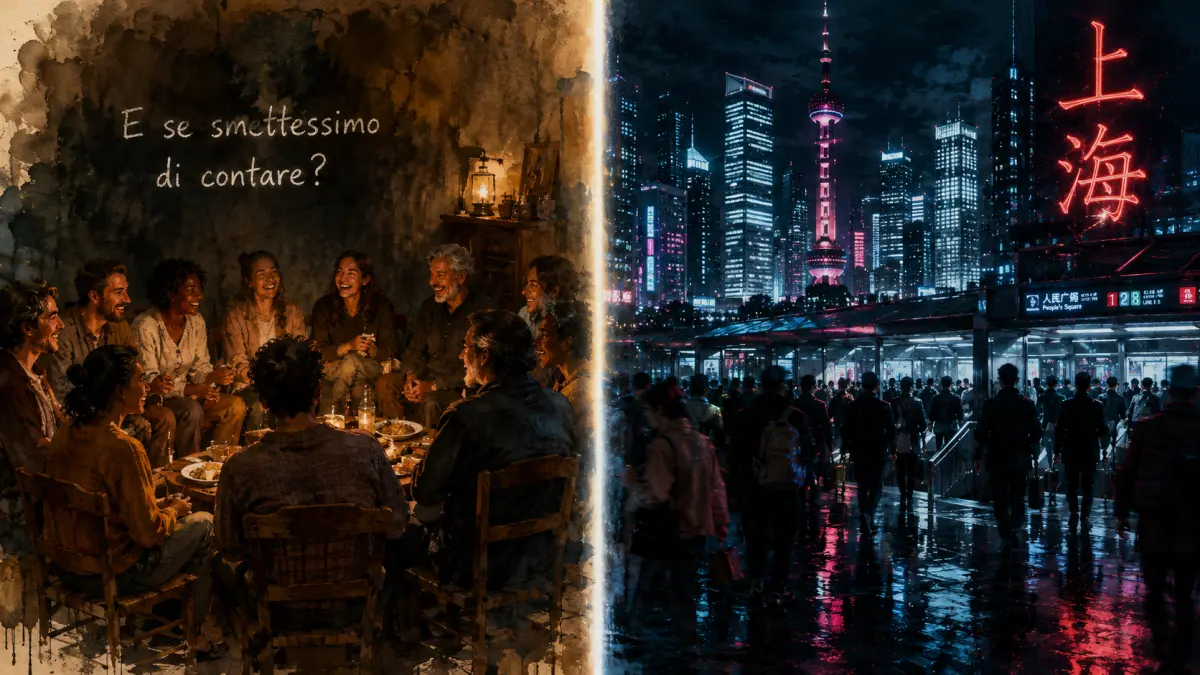
Ma poi ho alzato lo sguardo dal monitor e ho osservato lo skyline di Shanghai — quei grattacieli di vetro, le luci al neon che non dormono mai, il mare di volti senza espressione che si precipitano nelle stazioni della metropolitana.
But then I looked up from my screen and gazed at the Shanghai skyline — those glass-curtain skyscrapers, the neon lights that never sleep, the sea of expressionless faces rushing through subway stations.
但当我抬起头,看着窗外上海的天际线——那些玻璃幕墙的摩天大楼,那些彻夜不眠的霓虹灯,那些地铁里行色匆匆、面无表情的面孔——我突然笑了。
E ho sorriso. Un sorriso amaro.
And I smiled. A bitter smile.
一种苦涩的笑。
Perché lo so: questo esperimento non sopravviverebbe un trimestre a Shanghai.
Because I know: this experiment wouldn’t survive a single quarter in Shanghai.
因为我知道:这个实验,在上海活不过一个季度。
2. La Prima Delusione: La Fiducia è un Bene di Lusso / The First Disillusion: Trust Is a Luxury Good / 第一重幻灭:信任,是一种奢侈品
Il “No Money Club” è costruito sulla fiducia. La fiducia tra le persone — chiara, dolce e non misurata come l’acqua di un antico pozzo di villaggio.
The “No Money Club” is built on trust. Trust between people — as clear, sweet, and unmeasured as the water from an ancient village well.
“无钱俱乐部”的基石是信任。人与人之间的信任,像古村的井水,清澈、甘甜、无需计量。
Ma a Shanghai, la fiducia è un bene di lusso. Il pendolarismo medio dura 45 minuti. Lo spazio abitativo pro capite è inferiore a 30 metri quadri. Le persone cambiano casa in media ogni 3 anni. Non conosci il nome del tuo vicino. Potresti persino non ricordare il volto del tuo collega l’anno prossimo. In una città come questa, come si può costruire quel tipo di fiducia profonda e paziente che richiede anni per crescere?
But in Shanghai, trust is a luxury good. The average commute is 45 minutes. Living space per person is under 30 square meters. People move homes every 3 years on average. You don’t know your neighbor’s name. You might not even remember your colleague’s face next year. In a city like this, how can you build the kind of deep, patient trust that takes years to grow?
但在上海,信任是一种奢侈品。这里的平均通勤时间是45分钟,人均居住面积不到30平米,平均每3年搬一次家。你的邻居你不知道姓什么,你的同事你可能明年就不认识。这样的城市,怎么建立那种细水长流的信任?
Gli antichi dicevano: “Una lunga strada mette alla prova la forza del cavallo; il tempo rivela il cuore dell’uomo.”
The ancients said: “A long road tests a horse’s strength; time reveals a person’s heart.”
古人说:“路遥知马力,日久见人心。”
Ma a Shanghai non c’è “lunga strada” — solo treni ad alta velocità e contratti in scadenza. Non c’è “tempo” — solo scadenze e scadenze che scadono.
But in Shanghai, there is no “long road” — only high-speed trains and expiring contracts. There is no “time” — only deadlines and expiring leases.
但在上海,没有”日久”,只有”速食”。没有”路遥”,只有”虹桥枢纽”。
Piantare la fiducia in questo terreno non è seminare. È sacrificare.
To plant trust in this soil is not sowing. It’s sacrifice.
在没有信任的地方推行信任,不是在播种,而是在献祭。
3. La Seconda Delusione: Il Tempo Costa Più del Denaro / The Second Disillusion: Time Is More Expensive Than Money / 第二重幻灭:时间,比金钱更贵
Il “No Money Club” presuppone che le persone abbiano tempo abbondante per riunioni, discussioni e sostegno reciproco. Ma che dire degli abitanti di Shanghai?
The “No Money Club” assumes people have abundant time for gatherings, discussions, and mutual support. But what about the people of Shanghai?
“无钱俱乐部”假设大家有充足的时间参与聚会、讨论、互助。但上海人呢?
Escono di casa alle 7 del mattino. Rientrano alle 10 di sera. I fine settimana sono per le ripetizioni dei figli, il pagamento del mutuo e un’ora in palestra. Non sono riluttanti ad aiutare gli altri — possono a malapena riprendere fiato.
They leave home at 7 AM. They return at 10 PM. Weekends are for children’s tutoring, mortgage payments, and squeezing in a gym session. They’re not unwilling to help others — they can barely catch their own breath.
他们在早上7点出门,晚上10点回家。周末要陪孩子上补习班,要还房贷,要挤时间去健身房。他们不是不愿意帮助别人,他们是连自己的呼吸都要计时。
Tu dici: “Vieni al nostro circolo di mutuo aiuto — basta dedicare un po’ del tuo tempo.”
You say: “Come join our mutual aid circle — just contribute a little bit of your time.”
你说:”来参加我们的互助会吧,只要每次贡献一点点时间。”
Loro chiedono: “Quanto sarebbe ‘un po’? Se passo quest’ora a fare un lavoretto in freelance, potrei guadagnare 200 yuan. Mi risarcirai?”
They’ll ask: “How much is ‘a little’? If I spend this hour doing freelance work, I could make 200 yuan. Will you compensate me?”
他会反问你:”一点点是多少?我这一小时,如果用来做兼职,可以赚200块。你赔我吗?”
Questo non è egoismo. Questo è sopravvivenza.
This isn’t selfishness. This is survival.
这不是自私,这是生存。
4. La Terza Delusione: La Città è un Tempio del Profitto, Non della Rettitudine / The Third Disillusion: The City Is a Temple of Profit, Not Righteousness / 第三重幻灭:城市是”利”的庙堂,而非”义”的道场
L’anima del “No Money Club” è ciò che gli antichi confuciani chiamavano “yi” (義) — rettitudine, lealtà, umanità.
The soul of the “No Money Club” is what ancient Confucians called “yi” (義) — righteousness, loyalty, human-heartedness.
“无钱俱乐部”的灵魂,是中国古代儒家所说的”义”——道义、情义、仁义。
Ma l’essenza di Shanghai è “li” (利) — efficienza, profitto, ritorno sull’investimento.
But the essence of Shanghai is “li” (利) — efficiency, profit, return on investment.
但上海的本质,是”利”——效率、利润、资本回报率。
Puoi chiamare Shanghai un centro finanziario, un polo logistico, un gigante dell’innovazione tecnologica. Ma faresti fatica a chiamarla “centro di calore umano”. Più una città è sviluppata, più i suoi legami umani si assottigliano. Questo non è declino morale — è evoluzione sistemica.
You can call Shanghai a financial center, a shipping hub, a tech innovation powerhouse. But you’d struggle to call it a “center of human warmth.” The more developed a city becomes, the thinner its human connections grow. This isn’t moral decay — it’s systemic evolution.
你可以说上海是金融中心、航运中心、科创中心。但你很难说上海是”情义中心”。城市越发达,人情越稀薄,这不是道德的堕落,这是系统演化的必然。
Quando la misura di una persona passa da “chi sei” a “quanto possiedi”, qualsiasi relazione che rifiuti di contare, misurare, esigere ritorni, viene liquidata come ingenua — o sospetta.
When society’s measure of a person shifts from “who you are” to “what you own,” any relationship that refuses to count, to measure, to demand returns, is dismissed as naive — or suspicious.
当一个社会的评价体系从”你是什么样的人”转向”你拥有多少东西”,那么所有不带计量、不求回报的关系,都会被视为”幼稚”或”可疑”。
5. Il Paradosso: Perché Ne Abbiamo Ancora Bisogno / The Paradox: Why We Still Need It / 悖论:为何我们仍然需要它
Dopo aver elencato tutti gli “impossibili”, devo ammettere questo:
After laying out all the “impossibles,” I must admit this:
在说完了所有”不可能”之后,我必须承认:
Proprio perché Shanghai è così fredda, abbiamo più che mai bisogno del “No Money Club”.
Precisely because Shanghai is so cold, we need the “No Money Club” more than ever.
正因为上海如此冷漠,我们才比任何时候都更需要”无钱俱乐部”。
Non perché possa cambiare la città. Ma perché può salvare singoli esseri umani esausti e in difficoltà.
Not because it can change the city. But because it can save individual, exhausted, struggling human beings.
不是因为它能改变城市,而是因为它能拯救具体的、活生生的、疲惫的人。
È una corrente contraria spirituale. Una bolla che occasionalmente affiora nel torrente del capitale. Sussurra a quel giovane che lavora fino a mezzanotte a Lujiazui: “Non sei una macchina. Sei una persona degna di cura.”
It is a spiritual countercurrent. A bubble that occasionally floats to the surface in the torrent of capital. It whispers to that young person working overtime in Lujiazui until midnight: “You are not a machine. You are a person worthy of care.”
它是一种精神逆流。是在资本的洪流中,偶尔浮出水面的一个气泡。它告诉那个每天在陆家嘴加班到凌晨的年轻人:你不是一台机器,你是一个值得被关心的人。
6. Una Proposta in Stile Cinese per il “No Money Club” / A Chinese-Style Proposal for the “No Money Club” / 给”无钱俱乐部”的中国式建议
Se questo progetto volesse davvero venire in Cina, mettere radici qui, ascolta il consiglio di un locale:
If this project truly wants to come to China, to plant roots here, take advice from a local:
如果你真的想来中国,想在这片土地上扎根,请听一个本地人的忠告:
1. Non cercare di entrare nel centro città. Vai in periferia. Vai in comunità dove le persone già si conoscono. Vai nei quartieri dove il tempo scorre più lentamente.
1. Don’t try to enter the city center. Go to the suburbs. Go to communities where people already know each other. Go to the neighborhoods where time moves slower.
1. 不要试图进入市中心。 去郊区,去社区,去那些人们已经彼此认识的地方。
2. Non rifiutare il denaro — ma domalo. Usa piccole somme per coprire l’affitto e le forniture, ma tieni il denaro alla “soglia”. Le vere relazioni accadono dentro.
2. Don’t reject money — but tame it. Use small amounts to cover rent and supplies, but keep money at the “doorstep.” The real relationships happen inside.
2. 不要拒绝金钱,但要驯服它。 用少量的钱支付租金和物资,但让金钱止步于”门口”。真正的关系,在门内发生。
3. Accorcia i cicli. Non misurare le relazioni in anni — usa mesi o persino settimane. Gli abitanti delle città ricordano solo le cose successe negli ultimi tre mesi.
3. Shorten the cycle. Don’t measure relationships in years — use months, or even weeks. City people only remember things that happened within the last three months.
3. 缩短周期。 不要用”年”来计算关系,用”月”甚至”周”。城市里的人,只记得住三个月以内的事。
4. Coltiva gli “anziani”. Nella cultura cinese, un gruppo senza un anziano rispettato è facilmente disperso. Servono persone che non hanno potere formale, ma che portano il peso della memoria e dell’autorità morale della comunità.
4. Cultivate “elders.” In Chinese culture, a group without a respected elder is easily lost. You need people who hold no formal power, but who carry the community’s memory and moral weight.
4. 培养”长者”。 在中国文化里,一个没有”威望老人”的群体,是容易走散的。你们需要那些不用权力、却能凝聚人心的灵魂人物。
7. Conclusione: Un Fuoco di Prateria Inizia con una Scintilla / Conclusion: A Prairie Fire Starts with a Single Spark / 结语:燎原之火,始于草芥
In Cina, c’è un detto che ha ispirato innumerevoli rivoluzionari e riformatori:
In China, there’s a saying that has inspired countless revolutionaries and reformers:
在中国,有一句话激励了无数革命者和改革者:
“Una scintilla può incendiare la pianura.”
“A single spark can start a prairie fire.”
“星星之火,可以燎原。”
Ma questa frase viene spesso fraintesa. La gente pensa che la scintilla sia una “grande visione”. No. È un piccolo gruppo di persone, in un angolo specifico, che fa piccole cose concrete.
But this phrase is often misunderstood. People think the spark is a “grand vision.” No. It is a small group of people, in a specific corner, doing small, concrete things.
但这句话往往被误读。人们以为星星之火是”宏大理念”。不,它不是。它是具体的一小群人,在一个具体的角落,做具体的小事。
Shanghai continuerà a prosperare. Il denaro continuerà a fluire. I prezzi degli immobili non scenderanno. Ma se un giorno, in fondo a qualche vicolo stretto, vedi un cerchio di persone sedute insieme — che non parlano di soldi, né di case, né degli esami dei figli — ma che condividono semplicemente un pasto, una storia, un momento di silenzio —
Shanghai will continue to prosper. Money will keep flowing. Property prices won’t fall. But if one day, deep in some narrow alley, you see a circle of people sitting together — not talking about money, not about housing, not about children’s exams — just sharing a meal, a story, a moment of quiet —
上海会继续繁华,钱会继续流动,房价不会下跌。但如果你在某个弄堂深处,看到一群人围坐在一起,不谈钱、不谈房子、不谈孩子升学——他们只是在分享一顿饭、一个故事、一段安静的时间——
Fermati. Guardali. Perché potrebbe essere il tradimento più gentile del futuro, che sta accadendo proprio ora.
Please stop. Look at them. Because that might be the gentlest betrayal of the future, happening right now.
请你停下来,看看他们。因为那可能是未来,对今天最温柔的背叛。
Nota Finale dell’Autore / Author’s Final Note / 作者结语
Salvatore Martino
Questo articolo nasce da una conversazione profonda, iniziata con un semplice atto costitutivo e trasformatasi in un dialogo tra culture, tra sogni e realtà.
This essay was born from a deep conversation, which began with a simple founding document and transformed into a dialogue between cultures, between dreams and reality.
这篇文章源于一场深刻的对话,始于一份简单的成立文件,却演变成了一次文化与文化、梦想与现实之间的对话。
Il No Money Club non è un manifesto politico. Non è una setta. Non è la soluzione ai mali del mondo.
The No Money Club is not a political manifesto. It is not a sect. It is not the solution to the world’s ills.
No Money Club不是政治宣言,不是教派,不是世界弊病的解药。
Il No Money Club è solo un esperimento sociale.
The No Money Club is just a social experiment.
No Money Club只是一个社会实验。
Un esperimento che prova a chiedersi: “E se per un momento smettessimo di contare?”
An experiment that dares to ask: “What if, for a moment, we stopped counting?”
一个试着问”如果此刻我们停止计算会怎样?”的实验。
Non abbiamo certezze. Non abbiamo risposte. Abbiamo solo il coraggio di porci la domanda, e la pazienza di ascoltare chi ci risponde — anche quando la risposta è un pugno nello stomaco.
We have no certainties. We have no answers. We only have the courage to ask the question, and the patience to listen to those who answer — even when the answer is a punch to the gut.
我们没有确定的答案。我们只有提出问题的勇气,和倾听回答的耐心——即使那答案是重重的一拳。
Questo scritto non vuole scoraggiare né celebrare. Vuole solo ricordare che ogni grande cambiamento è iniziato come un’ipotesi fragile, un dubbio, un “e se…?”
This writing does not intend to discourage or celebrate. It only wants to remind us that every great change began as a fragile hypothesis, a doubt, a “what if…?”
这篇文章不打算打击谁,也不打算歌颂什么。它只想提醒我们:每一次伟大的改变,都始于一个脆弱的假设,一个疑问,一个”如果……?”
Il No Money Club è un’ipotesi. E le ipotesi, per diventare teorie, devono essere messe alla prova.
The No Money Club is a hypothesis. And hypotheses, to become theories, must be tested.
No Money Club是一个假设。而假设,要成为理论,必须接受检验。
Che sia a Milano, a Shanghai o in un piccolo villaggio dello Zhejiang, l’esperimento continua. Con umiltà. Con onestà. Con la consapevolezza che potremmo sbagliare, e che proprio questo — il coraggio di sbagliare — è il primo passo per imparare.
Whether in Milan, Shanghai, or a small village in Zhejiang, the experiment continues. With humility. With honesty. With the awareness that we might be wrong, and that this very thing — the courage to be wrong — is the first step toward learning.
无论是在米兰、上海,还是在浙江的一个小村庄,这个实验都在继续。带着谦卑,带着诚实,带着”我们可能会犯错”的意识——而正是这种敢于犯错的勇气,才是学习的第一步。
Grazie a chi ha letto, a chi ha dubitato, a chi ha creduto. E grazie a quella città lontana, Shanghai, che con il suo silenzio di vetro e acciaio ci ha insegnato che i sogni, per sopravvivere, devono imparare a camminare sulla terra.
Thank you to those who read, who doubted, who believed. And thank you to that distant city, Shanghai, which with its silence of glass and steel has taught us that dreams, to survive, must learn to walk on the earth.
感谢每一位读者,每一位怀疑者,每一位相信者。感谢那座遥远的城市——上海,用它玻璃与钢铁的沉默教会我们:梦想若要生存,必须先学会脚踏实地。
— Salvatore Martino
autore di pensai.eu
Pubblicato originariamente su offlinemind.com — uno spazio per il pensiero profondo e la vita offline.
Originally published on offlinemind.com — a space for deep thinking and offline living.
首发于 offlinemind.com —— 一个深度思考与离线生活的精神角落。
realizzato con la collaborazione alla stesura di deep seek ia
Views: 1